The One Stretch Baseball and Softball Players Should Stop Doing
- undefeatedptandper
- Jun 8, 2025
- 3 min read
If you’re a baseball or softball player — or a parent or coach of one — you’ve probably seen or used the sleeper stretch. It’s that common stretch where an athlete lies on their side, rotates their arm inward, and pushes the forearm down toward the floor to stretch the back of the shoulder.
The intention behind this stretch is usually to improve internal rotation, especially in throwers who experience what’s known as GIRD — glenohumeral internal rotation deficit. But here’s the thing: GIRD is a completely normal adaptation in throwing athletes.
Let me explain why this stretch might be doing more harm than good — and what to do instead.
Why GIRD Isn’t Always a Problem
When a baseball or softball player throws, their shoulder goes into a significant amount of external rotation (what we call “layback”) during the cocking phase of the throw. Over time, the body adapts to this repetitive motion. One of the most common adaptations is a loss of internal rotation — or GIRD (Glenohumeral Internal Rotation Deficit).
But this loss isn’t necessarily a bad thing. It’s your body adjusting to the demands of throwing. Trying to aggressively “stretch it back” can create more problems than it solves.
Why the Sleeper Stretch Can Be Harmful
Many players and coaches use the sleeper stretch thinking it’ll help regain internal rotation or loosen up the back of the shoulder. But here’s the issue: this position closely mimics a special test we use to detect shoulder impingement.
Ever heard of the Hawkins-Kennedy test? It’s a clinical test where we bring the arm across the body and internally rotate it, looking for pain in the front of the shoulder — essentially jamming the humerus into the top of the shoulder (the acromion). That’s exactly what’s happening during the sleeper stretch.
So, not only are you not stretching something that needs to be stretched (because your body has adapted for performance), but you’re also irritating the front of the shoulder — especially the rotator cuff tendons — right before you throw. Not good.
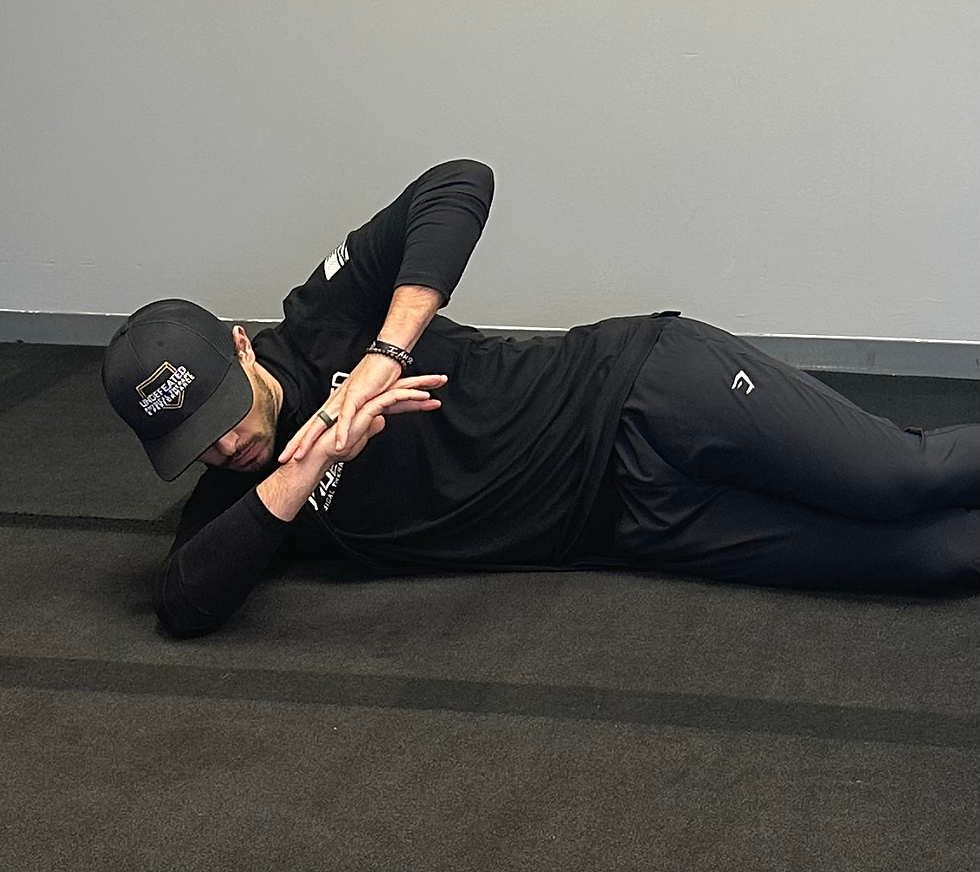
A Better Alternative: The Genie Stretch
Instead of cranking on your shoulder in a risky position, I recommend trying the genie stretch. This stretch is simple, effective, and doesn’t provoke irritation.
Here’s how to do it:
1. Stack your arms across your chest like you’re doing the “genie pose.”
2. Gently pull the elbow of the bottom arm across your body.
3. You should feel a stretch across the back of your shoulder and between the shoulder blades.
The genie stretch targets the posterior shoulder region and helps mobilize the scapula — without jamming the joint.

Focus on the Right Muscles
When throwers do have soft tissue limitations, it’s often not the joint capsule that’s tight — it’s usually the teres major and latissimus dorsi. These muscles play a major role in throwing and often get tight due to overuse or lack of mobility work. Addressing these areas with soft tissue techniques, mobility drills, and targeted stretching is a much safer and more effective way to support healthy throwing mechanics.
Final Thoughts
If you’re still using the sleeper stretch as part of your warm-up or recovery routine, it might be time to reconsider. While it’s a popular stretch, it doesn’t reflect the latest understanding of throwing athlete anatomy and can actually cause more irritation than benefit.
Instead, opt for smarter strategies like the genie stretch, soft tissue work for the teres and lats, and mobility exercises that support performance without risking inflammation or impingement.
In need of a custom Arm Care Program that address your limitations?
📞 Call or Text: 412-627-2131
📧 Email: carmen@undefeatedpt.com
📱 Message us on Instagram: @undefeated_pt
We’re always happy to answer your questions and help you get started on the right path. Let’s talk soon!


Comments