The Missing Link in Your Pre-Throw Program: Start From the Ground Up
- undefeatedptandper
- May 10
- 3 min read
By Dr. Carmen Jansante, PT, DPT, CSCS Undefeated Physical Therapy & Performance – Pittsburgh, PA

When it comes to pre-throw programs, most athletes immediately think about the shoulder and elbow—and for good reason. But one major piece is often missing: the ground.
If we truly want to prepare the body to throw at a high level, we have to emphasize the entire body. That means starting from the ground up.
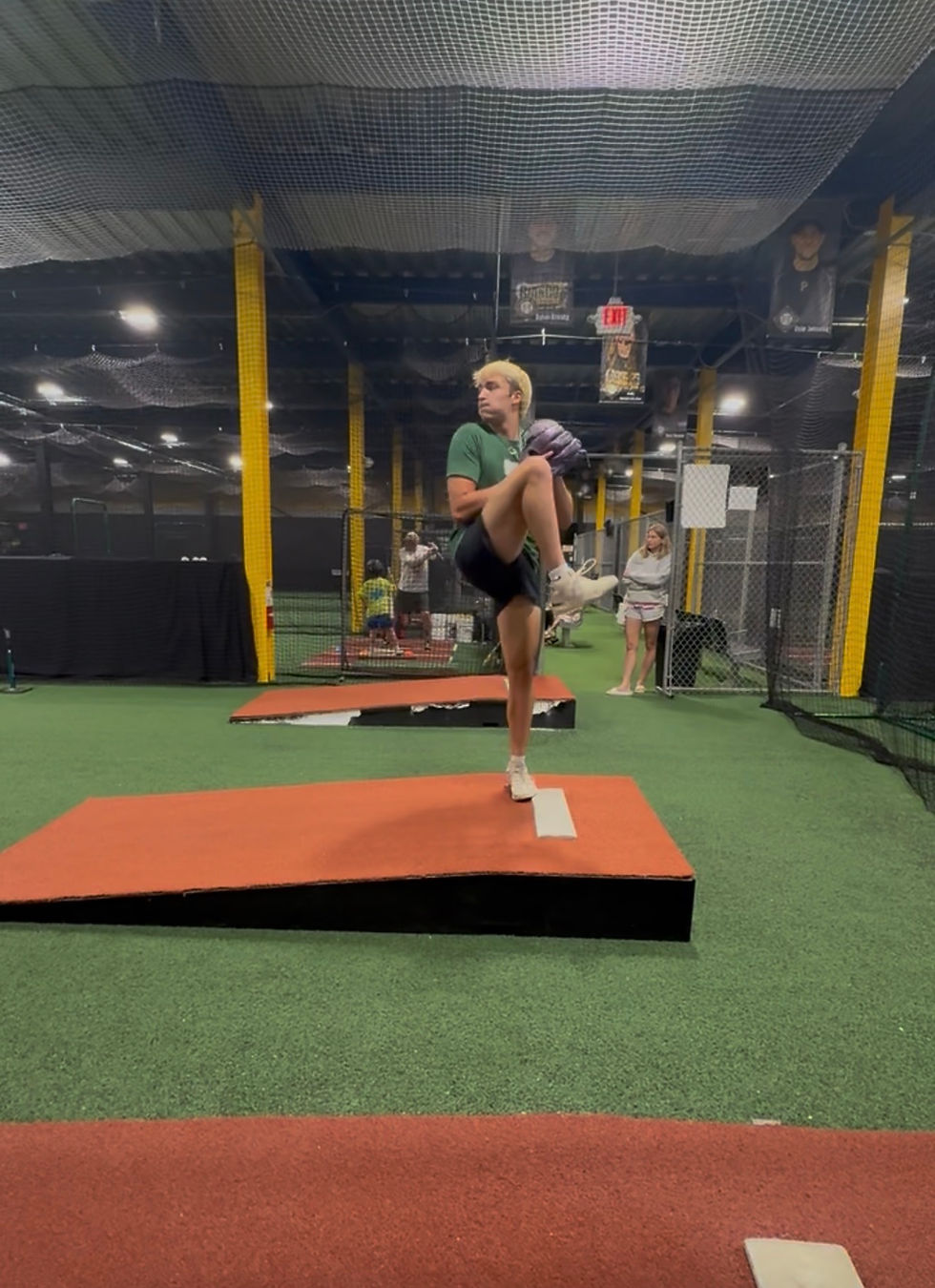
When you throw, you’re going to be on each leg by itself at some point. Whether you’re driving down the mound or landing into foot strike, single-leg stability is non-negotiable. And where does that all begin? Your feet.
Your feet are sensory. The sensation they provide tells your body where you are in space. The intrinsic foot muscles play a major role in stabilizing you, helping distribute weight, and allowing you to effectively drive into the ground.
Gravity is constantly applying force straight down through your body. In response, the ground gives you something back—ground reaction force—pushing straight up into you. The better you can use the ground, the more efficiently you can transfer energy up the chain.
That doesn’t just help performance—it helps protect you.
If you can utilize the ground effectively, you’re not only setting yourself up to throw with more accuracy and velocity, but you’re also putting yourself in a better position to reduce injury risk over time.
The Simple Exercise You’re Probably Missing
One of the easiest ways to start working from the ground up is by waking up the bottom of your feet.
Self-myofascial release of the foot using a lacrosse ball.
It’s simple, quick, and effective.
Take your shoes off
Place a lacrosse ball under your foot
Roll from heel to toe with good pressure
Perform about 20 smooth, rhythmic rolls
Then:
Find tender or sore spots
Apply firm pressure through the ball
While holding pressure, open and close your toes
This helps activate the intrinsic foot muscles and increases sensory input. Before you even start your warm-up, you’re already improving your body’s awareness and stability.
Why This Matters
This small exercise can have a big impact.
By improving foot activation and sensation, you can enhance your ability to stabilize on one leg. That’s critical for throwing athletes.
Research has shown that decreased efficiency in single-leg stance is associated with an increased incidence of elbow injuries, including UCL injuries that can lead to Tommy John surgery.
At first glance, that might not seem to make sense—what does your foot have to do with your elbow?
But think about it.
If you’re driving or landing on one leg and that leg is weak, unstable, or lacks awareness, your hip can drop. When your hip drops, your arm angle changes. Now your arm is taking on more stress than it should.
That’s how energy leaks happen in the kinetic chain—and how unnecessary stress ends up at the elbow.
What the Best Are Doing
This isn’t just theory—you can see it in high-level athletes.
Take Paul Skenes, for example. In a widely circulated warm-up video, one of the things he’s doing early on is rolling out his feet.
The best in the game understand: performance starts from the ground up.
How We Build It In
With our athletes at Undefeated Physical Therapy & Performance, this is just the starting point.
After foot activation, we always follow it up with at least one exercise performed barefoot to reinforce stability and sensation.
One of my go-to exercises is water bag chops.
The shifting water inside the bag creates constant perturbations, forcing the foot, ankle, knee, hip, and core to all work together to stabilize. It’s a simple way to integrate the entire system after activating the feet.
Final Thoughts
If you’re only focusing on your arm in your pre-throw routine, you’re missing the bigger picture.
Start from the ground up.
Wake up your feet. Improve your awareness. Build stability where it matters most.
Because better input from the ground leads to better output through the arm.
References
Kibler, W. Ben, et al. “The Role of the Kinetic Chain in Athletic Shoulder Function.” Sports Medicine, 2006.
MacWilliams, B.A., et al. “Characteristic Ground-Reaction Forces in Baseball Pitching.” The American Journal of Sports Medicine, 1998.
Zaremski, J.L., & Krabak, B.J. “Shoulder and Elbow Injuries in the Overhead Athlete.” Clinics in Sports Medicine, 2016.
Fong, D.T., et al. “Understanding Acute Ankle Ligamentous Sprain Injury in Sports.” Sports Medicine, 2007.
Needle, A.R., et al. “Sensorimotor Contributions to Lower Extremity Stability.” Journal of Orthopaedic & Sports Physical Therapy, 2017.


Comments