How Your Ankles Could Be Limiting Your Athletic Performance (And What to Do About It)
- undefeatedptandper
- Apr 19
- 3 min read

By Dr. Carmen Jansante, PT, DPT, CSCS
When athletes think about improving performance or recovering from injury, the ankle is often overlooked. But the truth is—everything starts from the ground up.
Every movement you make—running, cutting, throwing, lifting—begins with force interacting with the ground. That force travels up through your ankles, into your knees, hips, and eventually your upper body. If your ankles aren’t doing their job, something else will have to compensate.
Even if you’re dealing with an upper body injury, your ankles could be playing a bigger role than you think.
The Two Most Common Ankle Problems
Outside of obvious injuries like fractures or ligament tears, we typically see two main issues:
Mobility deficits
Stability deficits
Understanding which one you have is key to improving performance and preventing injury.
1. Ankle Mobility: Can You Move Enough?
The ankle moves in multiple directions—up (dorsiflexion), down (plantarflexion), and side-to-side. But the most common limitation we see is restricted dorsiflexion (bringing your toes toward your shin).
Why This Matters
Limited dorsiflexion affects any movement where you need to lower your body or move forward, such as:
Squatting
Lunging
Sprinting
Landing
If your ankle can’t move forward properly, your body can’t shift its center of mass efficiently. That means compensations—often at the knee, hip, or even the lower back.
A Common Cause: Tight Calves
Many athletes develop tight calves simply from daily positioning and sleep. When your foot stays in a pointed (plantarflexed) position for long periods, stiffness builds over time.
What Actually Helps?
Stretching alone isn’t always enough.
One of our go-to exercises is a banded ankle dorsiflexion mobilization:
Place a resistance band around the front of your ankle
Anchor it behind you
Drive your knee forward over your toes while the band pulls backward
Hold and repeat
This helps restore the natural mechanics of the ankle joint, specifically how the talus bone moves within the joint.
2. Ankle Stability: Can You Control It?
This is often the bigger issue.
Many athletes feel “tight,” but the real problem is lack of control, not lack of mobility.
Why Stability Matters
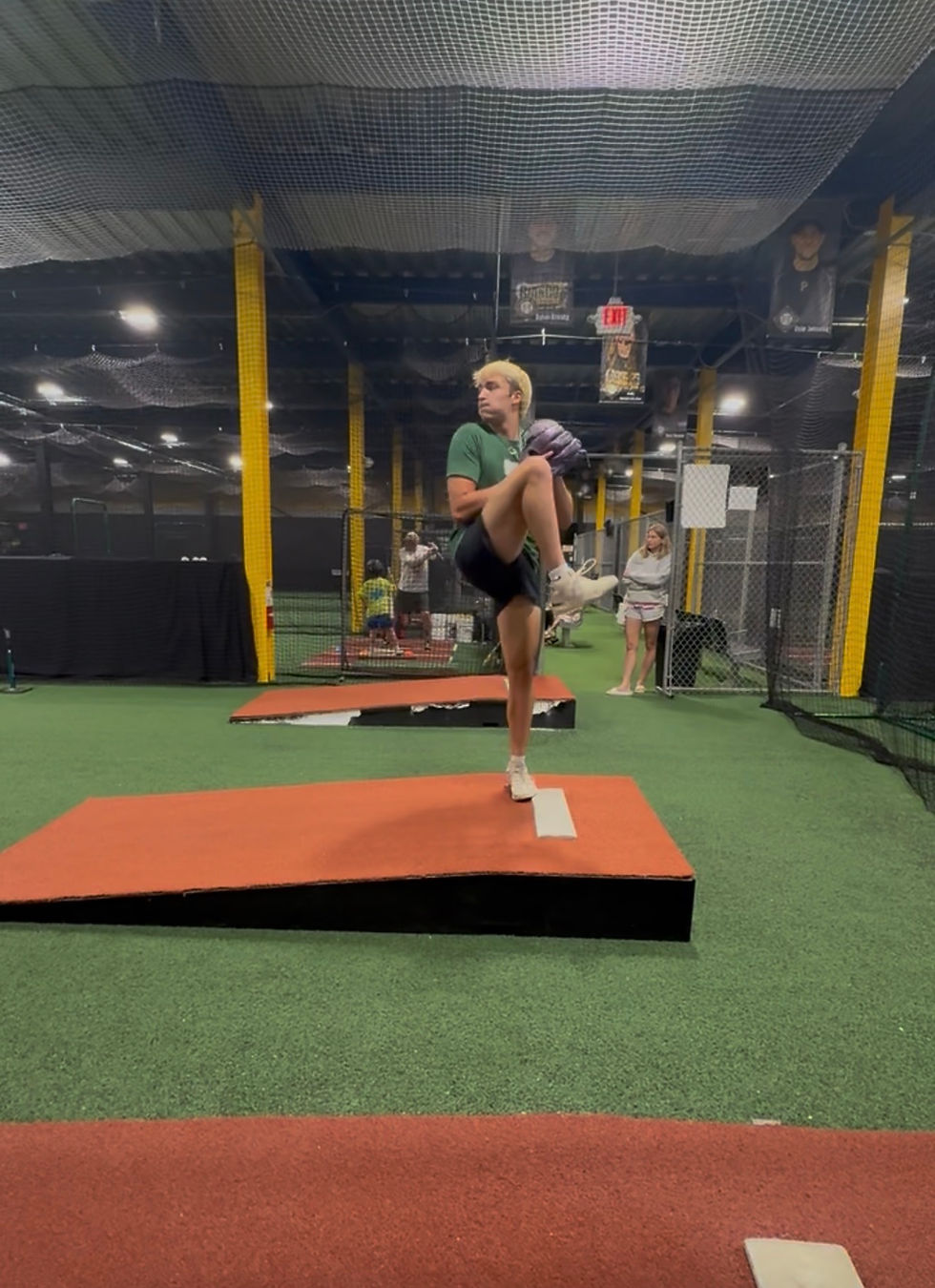
Stability is your ability to control movement—especially on one leg.
In sports like baseball, this is critical. Research has shown that poor single-leg balance is associated with a higher risk of elbow injuries, including UCL (Tommy John) injuries.
If you can’t control your lower half, your upper body takes on more stress.
Common Causes of Poor Stability
Previous ankle sprains
Ligament laxity
Muscle weakness
Poor neuromuscular control
What Stability Looks Like in Sport
Controlling your body during a pitch or swing
Absorbing force when landing
Producing power when pushing off
Simple Ways to Improve Stability
Start with single-leg work:
Single-leg balance holds
Single-leg RDLs
Split squats
Then progress to more dynamic exercises.
One of our favorites is the water bag chop in a split stance or single-leg position. This challenges your body to stabilize from the ground up before the arm ever gets involved.
Mobility vs. Stability: Which One Do You Need?
Here’s a quick way to think about it:
Feel stiff and limited? → Likely a mobility issue
Feel wobbly or unstable? → Likely a stability issue
Feel both? → You probably need a combination of both
The key is identifying the right problem so you can apply the right solution.
Why This Matters for Performance (and Injury)
Your ankles are your foundation.
If they aren’t working properly:
Force doesn’t transfer efficiently
Power output decreases
Stress shifts to other joints (like the knee, hip, or elbow)
For throwing athletes especially, poor ankle function can directly impact arm health and velocity.
Final Thoughts
If you’re dealing with an injury—or just feel like your performance isn’t where it should be—don’t overlook your ankles.
Sometimes the root cause isn’t where the pain is… it’s where the movement starts.
If you’re unsure whether mobility or stability is your issue, we can help guide you.
👉 Schedule a free consultation through our website
📱 Or text us at 412-627-2131
References
Hoch MC, Staton GS, McKeon PO. Dorsiflexion range of motion significantly influences landing biomechanics.
Dill KE et al. Lower extremity function and its relationship to upper extremity injury in baseball players.
Kibler WB, Sciascia A. Kinetic chain contributions to elbow function and injury risk in overhead athletes.
Fong DT et al. A systematic review on ankle injury and ankle sprain in sports.
McKeon PO, Hertel J. Systematic review of postural control and ankle instability.


Comments